
Write a Beautiful Eulogy
May I offer you my sympathy on your loss. If you are wondering how to write a eulogy, we have ideas for poems and speeches for you to create a memorable eulogy.
Eulogy Definition
Eulogies are spoken memorials given by family members or friends of someone recently deceased. A eulogy can express our innermost thoughts and feelings at a time when the right words can be hard to find.
Eulogies help remind those of us left behind, of happy memories and good times spent with our dearly departed. They offer an opportunity to say goodbye and bring some closure to his/her friends and family.
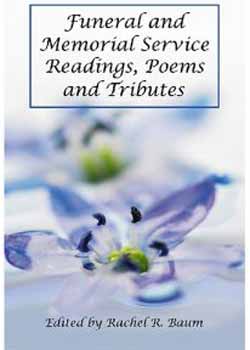
If you are looking for eulogy poems, may I suggest the book "Funeral and Memorial Service Readings, Poems and Tributes".
This book is a collection of poetry and prose appropriate for reading at a funeral or memorial service.
Whether you are preparing a eulogy speech, or wondering how to write a eulogy, you will want to make it a memorable occasion that is a real tribute to your loved one.
The following poem is a traditional Irish poem that is suitable for a eulogy.
The Parting Glass
Oh all the time that e'er I spent,
I spent it in good company;
And any harm that e'er I've done,
I trust it was to none but me;
May those I've loved through all the years
Have memories now they'll e'er recall;
So fill me to the parting glass,
Goodnight, and joy be with you all.
Oh all the comrades that e'er I had,
Are sorry for my going away;
And all the loved ones that e'er I had
Would wish me one more day to stay.
But since it falls unto my lot
That I should leave and you should not,
I'll gently rise and I'll softly call
Goodnight, and joy be with you all.
Of all good times that e'er we shared,
I leave to you fond memory;
And for all the friendship that e'er we had
I ask you to remember me;
And when you sit and stories tell,
I'll be with you and help recall;
So fill to me the parting glass,
God bless, and joy be with you all.
Eulogy Related Links
Seven Easy Steps to Writing a Eulogy
Gather Information for the Eulogy
Jot down as many personal notes about the deceased as possible. Look at photos. Flipping through photo albums may remind you of important qualities and memories of the person who died. Answer a few questions: What made your loved one truly happy? What inspired you to write this eulogy? What were your loved one’s passions? What will you remember most about this person? Keep in mind that a eulogy is not a biography but more your personal thoughts and remembrances from your point of view. You may want to ask co-workers, friends and others for their stories and memories. You should see some repetition in your notes and this will lead to the main theme.
Organize Content for the Eulogy
Outline the eulogy in these steps:
I. A beginning to establish your theme.
II. A middle section to build on your theme with personal stories, information, quotes, comments, sayings, poems and other content. This information should make up 90% of the eulogy.
III. A short conclusion to summarize your thoughts and restate your theme.
Work first on the middle section (Part II). Once you have this part the beginning and summary will be easy. Develop the outline by grouping similar themes from your notes from Step 1. For example, you might want to gather all the achievements together. Merge the comments about the deceased’s philosophy of life.
Organize the conclusion (Part III). A conclusion reminds the listeners of the theme and imprints the strong feeling you have about the loss. The key is to conclude effectively and quickly. Here is an example: “We will all miss Jackie’s sense of humor, her talent for knowing what is really important in life and her famous chocolate chip cookies” (a little humor doesn’t hurt as long as it’s not offensive to anyone). “Her example lives as an inspiration for all of us to follow.”
Write the beginning of the eulogy (Part 1). This usually starts with an attention getter. It will set the theme and can be in the form of a short story, a poem, a saying, lyrics to a song. It will introduce the goal and theme you used when you began the process.
Polish it up. Your best bet is to walk away from it for a few hours or overnight if possible. Work on it so it sounds like a conversation. You want to talk to the audience as naturally as possible.
Key Eulogy Writing Tips
Keep it short, 4-8 minutes long, 3-7 typed pages.
Type it out using 14 pt type so it’s easy to read.
Vary sentence length.
Number the pages.
Practice the eulogy aloud and time yourself.
Read it to friends and family and get their feedback.
Edit where necessary.
Keep the content in good taste and keep it positive.
Delivering the Eulogy
While normally speakers do not read word-for-word, because you are more than likely going to be emotional, don’t be afraid to read word for word. This way you won’t leave out any key points you or others wanted said. If making eye contact with members of the audience will make you emotional, either try and keep your eyes on the page or look just over the top of the audience to the back of the room.
Feel free to pause, take a deep breath and drink some water. Everyone will understand. They are emotionally distraught also.
Speak as naturally as you can just as if you were telling someone about your loved one. Speak up. It’s very important that you speak clearly and loudly so that everyone can hear you.
Keep the written eulogy as a memento. You can add it to your memento chest and share it with others who may want a copy.
By following these steps, writing and delivering a eulogy will become less stressful and more of a healing process.
To find some poems to get you started visit
poem4today.com.
Mary Hickey is an urn designer and thought leader in the funeral industry.
She is co-founder of Renaissance Urn Company, based in San Francisco.
For more information on how to plan a life celebration, visit
https://nextgenmemorials.com
Hickey can be reached at
https://nextgenmemorials.com/contact/.
Article Source: http://EzineArticles.com/?expert=Mary_Hickey
May I also suggest you visit Jan Shepardson's site on writing a loving eulogy for a funeral. After the loss of her mother, she has put together some information that will help you to write a eulogy. Just click on the link to Jan's site, Loving Eulogies.
Famous Eulogy Examples
Brooke Shields moving eulogy to her friend Michael Jackson
Kevin Costner's moving eulogy to his friend Whitney Houston
Earl Spencer's moving eulogy to his sister Princess Diana
If you are confident about how to write a eulogy speech, you may find the book "Funeral and Memorial Service Readings, Poems and Tributes" helpful. It contains over 50 eulogy poems, over 30 suggested hymns, suggested bible readings for a funeral and ideas for an order of service.
If you are looking for further help on how to write a eulogy or eulogy speech, with examples of written eulogies, and including ideas for:-
- eulogy for my wife
- eulogy for my husband
- mothers eulogy
- Eulogy for My Father
- eulogies for a friend
- death eulogies
- eulogy for a brother
- eulogy for a son
- eulogy for a daughter
Eulogy for Your Sister
Writing a eulogy for your sister will be a very emotional undertaking but it is your opportunity to show how much you love her by writing her a beautiful eulogy. Find a quiet place and spend some time remembering the memories you shared with your sister growing up. Some will be funny and some will be more serious. Choose a few that demonstrate the kind of person she was and why you will miss her. Talk to family and friends for their input. You will find the whole process cathartic and it will help you deal with your loss. You will find that your focus becomes more about her life than about her death and this will help you grieve.
May God bless you at this time,